The short answer
- Between 40% and 60% of inbound calls to trade contractors go completely unanswered.
- Up to 48% of US law firms are entirely unreachable by phone across live calls and callbacks.
- Modern conversational AI voice systems reduce peak call abandonment by 75%.
- Only 23% to 47% of veterinary front-desk staff ask incoming callers to book an appointment.
The Inbound Call Bottleneck in US Service Businesses#
You don't have a marketing problem. You have a 4pm problem.
Every hour you leave your inbound phones uncovered costs you real revenue. By the end of this breakdown, you will know the exact benchmark answer, abandonment, and booking conversion rates across US service sectors—and how to plug the leak this week.
Inbound calls remain the front door for your business. When a homeowner with a burst pipe, a client facing a lawsuit, or a patient in pain dials your number, speed dictates who gets the revenue. Trade-press benchmarks in home services show that 78% of customers buy from the first business that answers the call.
Yet most small service operations let half their inbound pipeline hit the floor. In a study across 22 medical practices in 18 states analyzing roughly 7,000 inbound calls, front-desk staff left 42% of calls completely unanswered. Solo and small practices routinely miss 30% or more of incoming volume.
Contractors face even worse drop-off. Trade industry data shows that mobile operators miss between 40% and 60% of inbound calls.
Trade benchmarks show that 80% of callers hang up when sent to standard voicemail. Even worse: 85% of consumers who experience an unanswered call will never call that business back.
When your phone rings out, the prospect does not wait. Patient-behavior surveys report that 62% of medical callers who reach voicemail hang up without leaving a word. A full 67% immediately dial a competing provider.
You paid to make the phone ring. Then your front desk missed the call.
Routing inbound customer calls to passive voicemail loses over 60% of prospects directly to your local competitors.
| Industry Sector | Average Live Answer Rate | Industry Abandonment Rate | Target Speed of Answer | Standard Conversion Benchmark |
|---|---|---|---|---|
| Healthcare & Medical Practices | 58% to 80% | 5.0% to 23.0% (Up to 42% peak miss) | Under 50 seconds (HFMA) / Under 2.0 min (CMS) | 50% to 60% appointment intent |
| Legal Practices | 40% (2024) to 56% (2019) | 48% unreachable (live + callback) | Immediate answer expected | 12% to 15% conversion lift with automation |
| Veterinary Practices | Unmeasured nationally | Under 5.0% target; ~40% after-hours miss | Under 3 rings | 60% or higher target (23% to 47% actual prompt rate) |
| Trades & Home Services | 40% to 60% | 40% to 60% missed or abandoned | Instant answer required | 78% buy from first responder |
The baseline numbers across every industry point to one operational truth.

Why Live Human Answering Fails the Intake Test#
Most owners believe hiring a live receptionist solves phone conversion instantly. The data shows otherwise.
Live answering human receptionists only work when two conditions hold true: they pick up immediately, and they know how to book the customer. In practice, both fail regularly.
Consider the legal sector. A mystery shopper study of 1,000 law firms commissioned by Clio found that in 2019, only 56% of phone calls were answered by a live human. Another 39% went straight to voicemail, and 27% of firms failed to answer or return a voicemail within 72 hours.
By 2024, Clio's re-evaluation across 500 law firms showed live answer performance had plummeted to 40%. Overall, 48% of law firms were completely unreachable by phone—they neither answered live nor returned messages.
When a live person did answer, they routinely botched the intake. Among law firms where secret shoppers reached a live staff member, 73% of callers reported that they were unlikely to recommend the firm based on that interaction.
Only 41% of live legal staff could share consultation or hourly rate information. Only 36% explained the firm's intake process and next steps. A tiny 12% could provide a total cost estimate.
Human presence does not equal human competence.
A primary MGMA Stat poll reveals why medical front desks drop the ball: administrative telephone work is swallowed by complex billing tasks. Insurance eligibility and prior authorizations consume 45% of time-consuming phone labor, while basic scheduling takes 31%. Because 76% of front-desk phone time is trapped in administrative lookups, incoming patient lines jam completely during morning rushes and lunch hours.
Veterinary clinics suffer the same gap. Observational research published in dvm360 established that only 23% of customer service representatives explicitly ask callers to schedule an appointment. Related research shows that 53% of front-desk staff never invite the caller to book a visit.
If your live receptionist never asks for the booking, your conversion rate stalls.
Live answering delivers a high recommendation rate only when reps give clear pricing, next steps, and direct scheduling.
Automated Answering Systems: Legacy IVR versus Conversational AI#
Owners who avoid phone automation usually remember legacy interactive voice response (IVR) systems.
Legacy IVR trees forced callers through rigid touch-tone menus. "Press 1 for service, press 2 for billing." Callers hated them, and the abandonment numbers prove it. Historical contact center evaluations at the Veterans Health Administration showed peak touch-tone IVR abandonment climbing to 29.1%.
Modern automated phone answering systems do not use touch-tone trees. They run specialty-aware conversational AI voice agents that speak naturally, integrate into your practice management software, and book appointments directly.
In healthcare contact centers, deploying conversational AI voice agents to handle routine appointment scheduling reduced call abandonment by 75%. It collapsed caller wait times from 90 minutes down to seconds.
In law firms, implementing tech-enabled intake, online schedulers, and automated workflows drove a 12% to 15% increase in lead conversion rates and lifted firm revenue by 20%.
Automation answers on ring one. It never forgets to ask for the booking.
The Math of Missed Calls: What Phone Friction Costs Your Business#
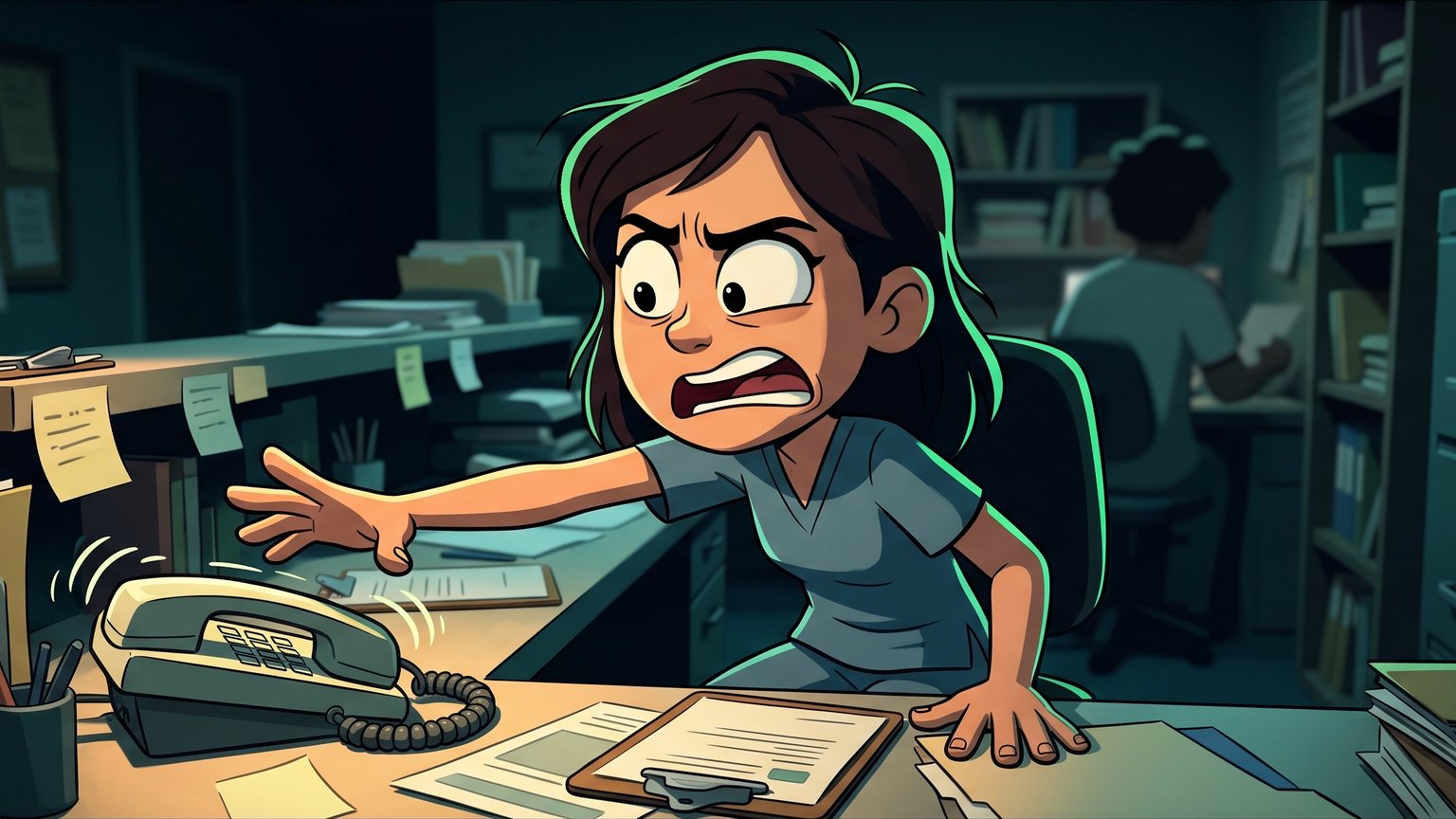
Phone leakage is not a theoretical metric. It drains your bank account every single month.
The formula for annual revenue at risk multiplies your volume, your missed call rate, customer booking intent, baseline conversion rate, average ticket value, and operational days:
Annual Revenue at Risk = Inbound Calls x Missed Rate x Intent Rate x Conversion Rate x Ticket Value x Business Days
Look at the arithmetic for a typical primary care medical practice:
- 60 inbound calls per day x 25% missed or abandoned = 15 unanswered calls daily.
- 15 unanswered calls x 50% appointment booking intent = 7.5 prospective appointments lost daily.
- 7.5 prospective appointments x 60% baseline conversion rate = 4.5 lost visits daily.
- 4.5 lost visits x $150 average visit value = $675 in revenue lost per day.
- $675 daily loss x 250 operational business days = $168,750 in annual revenue at risk.
A smaller clinic model published by Medical Office Force shows the exact same dynamic: 10 missed calls per day x 40% booking intent = 4 lost appointments per day. At $150 per visit across 20 operating days a month, the loss equals 4 x $150 x 20 = $12,000 every month, or $144,000 a year.
Solo trade operators face the same arithmetic: 22 missed calls per month without a callback at a $155 average job value equals 22 x $155 = $3,410 in lost monthly revenue, or roughly $40,800 a year.
After-hours volume magnifies the loss. In veterinary medicine, 40% of all inbound calls arrive outside regular business hours.
An analysis of after-hours veterinary demand shows that 85% of these calls do not require emergency doctor care:
- 15% are true medical emergencies requiring critical care routing.
- 30% are sub-24-hour urgent needs requiring next-day booking.
- 40% are routine inquiries needing standard scheduling.
- 15% are non-medical questions about hours or fees.
In a 15-location veterinary group receiving 45 after-hours calls a night, passive voicemail captures just 10% of non-emergency demand, converting 4.5 visits for $675 nightly at $150 per visit.
An automated triage and scheduling workflow captures 65% of those opportunities, converting 29 visits for $4,350 nightly.
The nightly difference is $4,350 - $675 = $3,675. Across a month, that gap exceeds $110,000 in recaptured revenue.
That is the cost of letting calls go to voicemail.
Audit your phone logs by hour of the day to identify call spikes during lunch breaks and after-hours windows.
How to Fix Your Phone Leak This Week#
Unassisted humans fail under peak call volume. Touch-tone IVR menus anger prospective clients.
Winning service businesses deploy a hybrid setup that combines instant automated answering with targeted human escalation:
- Deploy conversational AI for immediate answer. Eliminate hold times on routine inquiries. Let voice automation handle appointment booking, hours, directions, and routine intake directly inside your scheduling software.
- Train live staff on structured intake. When callers escalate to your front desk, enforce explicit scripts. Ensure your staff quotes clear fee ranges, explains the intake process, and asks for the appointment every single time.
- Automate after-hours scheduling. Replace passive voicemail boxes with an automated voice receptionist that books callers directly into next-day calendar slots.
- Audit hourly call records. Review your call detail records weekly. Identify when hold times exceed 50 seconds or abandonment tops 5%, and adjust your automated routing to absorb the spikes.
When you answer instantly and ask for the booking on every call, your phone transforms from a revenue leak into your most dependable sales channel.
Frequently asked
Does an auto answer phone system book more jobs than a live receptionist?
Modern conversational systems book more by eliminating unanswered rings, capturing after-hours volume, and removing hold queues. Live receptionists convert high-intent callers well, but fail when lines are busy or staff fail to ask for the appointment.
What is the average call abandonment rate for service businesses?
Healthcare practices average 20% to 23% abandonment, reaching 42% unassisted calls in small clinics. Trade contractors miss 40% to 60% of calls. Legacy touch-tone systems drive abandonment up to 29.1% during peak hours.
How many callers leave a voicemail when nobody answers?
Only 38% of healthcare callers leave a voicemail, while 62% hang up immediately. In trade businesses, 80% hang up on voicemail. Two out of three callers immediately ring a competitor rather than wait.
Why do live receptionists fail to convert callers?
In legal mystery shopper studies, 73% of callers who reached live staff reported poor experiences because reps could not answer basic questions. In veterinary clinics, 53% of staff never ask the caller to schedule.
The HeyFirstcall team — Call handling for service businesses
We run the answering service this research is about. Our own line takes live calls every day, including right now on (314) 784-8835. That is why these pieces separate what the published studies actually measured from what the industry repeats about them.
Every figure above is traced to a named source in the list below, and a figure we could not trace is labelled as untraced rather than quoted as fact. The same standard across every piece we publish is in our statistics, with the numbers that do not hold up.
An in-house trade receptionist costs $48,000–$65,000 annually for 24% time coverage, traditional answering services cost $7,200–$18,000, and trade AI answering services cost $1,200–$9,468 for 24/7 coverage.
Sources
- Phones are still a bottleneck costing medical practices time they can't afford
- Telephone tips: Meeting client expectations | dvm360
- ACVC 2016: What to Say to Convert a Phone Call Into an Appointment | dvm360
- Converting callers into clients | dvm360
- The phone shopper: your next potential "A" client & the phone shopper: turning the call into an appointment (Proceedings) | dvm360
- Phone Calls Ignored, Emails Unanswered: Fixing the First Impression Problem for Law Firms claim examined
- After-Hours Veterinary Call Management: 4 Proven Models claim examined
- What Happened After People Contacted These 1,000 Law Firms? - Firmidable claim examined
- Clio's Legal Trends Report Reveals Law Firms Struggle to Respond to Client Inquiries claim examined
- Clio's Legal Trends Report Reveals Law Firms Struggle to Respond to Client Inquiries - GlobeNewswire claim examined
- Latest Healthcare Call Center Statistics: Key Data Shaping the Industry Right Now claim examined
- Call Abandonment Rate in Healthcare: Benchmarks and How to Improve It - Assort Health claim examined
- Why Clinics Miss Patient Calls — and What Each One Costs (2026) - Anservo AI claim examined
- How Missed Calls Cost Medical Practices Thousands Each Month claim examined
Find out what your missed calls are actually costing
A free lead audit estimates how many of your calls go unanswered and what they are worth, from nine quick answers. No install, no contract.